Rechercher dans ce blog

Friday, November 4, 2022

What You Should Know If Your Colleague Is Returning To Work After Cancer - Forbes

nnnindonesia.blogspot.com

If you were to walk into your workplace, no matter how small, the likelihood is that someone there has been affected by cancer. A macabre version of ‘six degrees of Kevin Bacon’ - in which it’s suggested he can be linked to any other actor within six connections or less – cancer is so pervasive that you’re more likely to know someone who’s had it than not.

One in two people will develop cancer at some point in their lifetime, with breast cancer cited as the most common to be newly diagnosed. Given these statistics, it’s safe to assume that at some point in our careers, someone we work with is going to have been through it. Despite this, talking about it at work – particularly to colleagues currently in or returned from treatment – remains largely taboo.

According to research conducted by AXA PPP Healthcare in 2016, just one fifth of managers who had team members with cancer had discussed the illness with them, because they aren’t sure what to say. A Cancer and Employment survey by iES shows that this left many of these team members feeling under supported, with a clear need for more employers to offer a phased return, vocational rehabilitation and job redesign.

For Jessica Jackson - the protagonist in journalist and author Laura Price’s debut novel, Single Bald Female - who is diagnosed with breast cancer just days after landing her dream job as a magazine editor, quitting work just isn’t an option. Partly because she can’t afford it and partly because she just doesn’t want to – she loves her career, has worked hard to get to where she is and isn’t about to let it go easily. Though she takes the days after each chemotherapy session off, she works throughout her treatment, making this one of few modern depictions of what living with cancer might actually be like for a young woman with ambition.

“Jess’s career is important to her in terms of her mental health and her independence – she needs something to keep her going, and she doesn’t want people to feel sorry for her,” explains Laura, who wrote the book after going through a similar experience herself. Diagnosed with breast cancer at 29, when she initially returned to work, her colleagues were understanding, but as more time passed, they struggled to see her remission status as anything other than absolute.

“When I returned to work shortly after finishing chemotherapy, people were very understanding because I still had the physical signs of cancer such as a bald head,” she explains. “But later, when I still suffered from extreme fatigue and some days struggled to get out of bed, it was hard for my team to understand why I might not be up to working, or up to socialising after work.”

Now with a secondary diagnosis, Laura is once again navigating work and treatment at the same time.

“I was lucky enough to have paid leave when I underwent chemotherapy for primary breast cancer when I was 29, but I am now working full-time throughout ongoing treatment for secondary breast cancer at 40 because I have to for financial reasons, because the treatment is for the rest of my life and because I’m not too unwell to work.”

Despite what many cancer depictions in film and TV tell us, most women who have received treatment for cancer will have to return to work in some capacity afterwards. A large part of making that transition easier is having colleagues who provide adequate support.

So what is the best way to do this? It’s understandable that many of us worry about getting it wrong and as Laura points out, there’s no one-size-fits-all solution here, but there are actions we can take to make it less of a hurdle.

Don’t make assumptions

First of all, Laura suggests following the lead of your colleague and not assuming what they can or can’t do – even as more time passes by. “Remember that even if your colleague is not going through something as intense as chemotherapy, they may still be having other types of treatment,” she says. “There is every chance they are still suffering physical or mental side effects of some form, so be aware that their needs may change from week to week. Never assume their illness is completely in the past.”

Be direct

Unlike those managers unable to overcome their own awkwardness, Laura believes it’s best to have an honest conversation and actually ask the person what they need. “Don’t pussy-foot around your colleague or assume they are less capable than they were before. Be direct with them – ask them how they are feeling, and what they need from you. A simple “What do you need from me?” will go a long way.”

And for those with the illness…

“Decide on what your boundaries are,” Laura recommends, “whether you want your colleagues to know what’s going on with you on a personal level, and how you want to be treated. If you don’t want to be treated any differently, make that clear. But if you need more help or some extra flexibility, make that clear too. I always asked colleagues to ask me directly if they had any questions about my cancer – I didn’t want anyone talking or speculating behind my back – and Jess does the same in the book. But there really is no right or wrong way to handle returning to work after illness – you do you.”

Aside from articles and books, Laura also writes a newsletter. To follow her experiences, subscribe here.

If you or your colleagues need support on returning to work after cancer, you can contact the Macmillan Work Support Service here.

Adblock test (Why?)


"colleague" - Google News
November 04, 2022 at 08:38PM
https://ift.tt/eFg91HG

What You Should Know If Your Colleague Is Returning To Work After Cancer - Forbes
"colleague" - Google News
https://ift.tt/LHpJsXS
https://ift.tt/wt3Vgb0

Tuesday, November 1, 2022

TSX tech issue resolved after complete trading halt - Reuters

nnnindonesia.blogspot.com

OTTAWA, Nov 1 (Reuters) - The Toronto Stock Exchange(TSX) said its trading platforms were now running normally after about an hour of technical issues which led to the halt of all equities trading on Tuesday morning.

TSX-operator TMX Group posted a tweet about a connection issue with Canada's largest stock exchange at 10:12 local time (1412 GMT). Soon after, all trading was halted on TMX-run markets.

TMX said it experienced a technical issue that impacted client connectivity on its equities markets.

The issue was resolved and TSX's trading system status website showed all trading platforms and all related components were functioning normally at 11:20 local time.

Reporting by Ismail Shakil in Ottawa and Fergal Smith in Toronto; Editing by Chizu Nomiyama

Our Standards: The Thomson Reuters Trust Principles.

Adblock test (Why?)


"complete" - Google News
November 01, 2022 at 11:01PM
https://ift.tt/wq1lcP9

TSX tech issue resolved after complete trading halt - Reuters
"complete" - Google News
https://ift.tt/vVrW7ns
https://ift.tt/VyQPDoh

How a Fabled Fish Could Complete a Remarkable Comeback - The Pew Charitable Trusts

nnnindonesia.blogspot.com

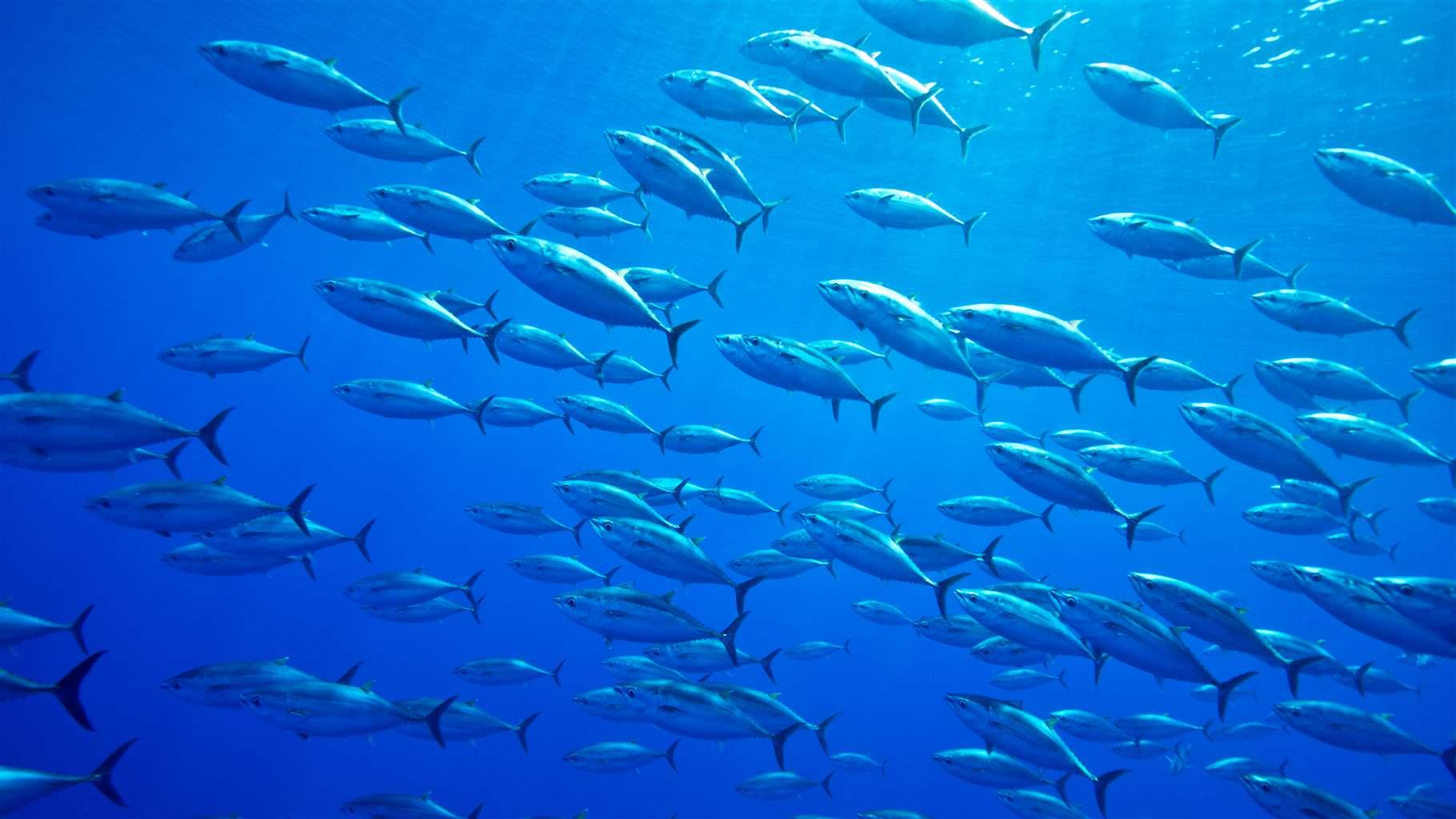
The Atlantic bluefin tuna has an incredible history. From the time ancient Mediterranean civilizations discovered this fish—which grows from the size of a grain of rice to that of a Clydesdale—to years of overfishing and mismanagement, the arc of the species represents not only the damage that people can do to nature but also how they can establish policies for the good of the ocean. Now, in November, the very governments responsible for managing this remarkable fish have the opportunity to take an important step to secure its sustainability.

The problems facing Atlantic bluefin tuna today began with too much fishing. For decades, the species has been highly prized—and priced—for sushi and sashimi markets, particularly in Japan. This drove an explosion of fishing from the Gulf of Mexico, where the western population of Atlantic bluefin spawns, to the Mediterranean Sea, where the eastern population spawns. The Mediterranean is also where the advent of bluefin “ranching” in the 1990s caused a huge—and detrimental—increase in fishing. Ranching involves catching wild fish and keeping them in huge pens, where they’re fattened up to Tokyo’s exacting raw fish standards. The millions of dollars generated by ranching were a large reason why fishery managers prioritized maximizing catch. 

Over the past three decades, managers, who represent their individual governments at the International Commission for the Conservation of Atlantic Tunas (ICCAT), frequently adopted catch limits as high as double the amount scientists advised would be sustainable. At the same time, illegal fishing in the Mediterranean was rampant, accounting for roughly the same volume of fish that were landed lawfully. The result: By 2009, the Atlantic bluefin population was approaching total collapse. That year, Prince Albert II of Monaco called for the Convention on International Trade in Endangered Species of Wild Fauna and Flora to ban all international trade of Atlantic bluefin—a proposal that nearly passed.

Flash forward to today. While the western population status has been slower to improve, the eastern Atlantic and Mediterranean population is well into a successful recovery—a turnaround that some fisheries experts thought was almost too good to be true.

How did that happen so quickly?

In part, because of the work of non-governmental organizations and civil society. Over the years, stakeholders have encouraged governments to adopt science-based fishery management measures and develop tighter tracking of bluefin catch and trade. As the science on bluefin populations developed, ICCAT began to adopt policies that substantially curbed illegal fishing and set catch limits low enough to allow the population to recover. As a result, the population in the eastern Atlantic Ocean and Mediterranean is no longer overfished, which in turn has allowed managers to increase catch limits from 13,500 metric tons in 2010 to 36,000 metric tons in 2022.

Still, the Atlantic bluefin recovery is not yet secure. ICCAT can significantly guard against collapse for this billion-dollar fish by adopting a “management procedure” (also known as a “harvest strategy”) for the species: a set of pre-agreed actions, such as raising or lowering catch limits, that are automatically triggered based on the status of the bluefin population. ICCAT will meet next month in Vale do Lobo, Portugal, where it could adopt a management procedure for Atlantic bluefin. In advance of the meeting, ICCAT’s own scientists just finished drafting such procedures for the Commission to consider.

The European Union, whose fleets catch more than half of the bluefin taken in the entire Atlantic, and Japan, whose importers buy the vast majority of it, must show leadership and support for this management procedure if it is to succeed. And the United States, Canada, Morocco, and others also have roles to play in developing and agreeing to this new rule.

If scientists’ forecasts are accurate, adopting this harvest strategy could help stabilize fisheries and markets, in part by lowering the chances that future halts to fishing would be needed. Consumers would have more confidence in the sustainability of the bluefin population from the eastern Atlantic Ocean and Mediterranean Sea, and the management procedure would even allow the western bluefin population to recover. Adoption this year is therefore the rare win-win-win for the seafood industry, consumers, and ocean health.

In a few weeks, fishery managers can ensure sustainability of Atlantic bluefin for many years to come. This ICCAT meeting could mark a turning point not only for the species, but also for how fisheries managers oversee highly sought after—and vulnerable—fish populations around the world.

Rachel Hopkins works on The Pew Charitable Trusts’ international fisheries project.

Adblock test (Why?)


"complete" - Google News
November 01, 2022 at 09:15PM
https://ift.tt/Gpjexgl

How a Fabled Fish Could Complete a Remarkable Comeback - The Pew Charitable Trusts
"complete" - Google News
https://ift.tt/vVrW7ns
https://ift.tt/VyQPDoh

Sainz relieved to complete F1 Mexican GP after Japan, US first-lap exits - Autosport

nnnindonesia.blogspot.com

However the Spaniard was left frustrated by a lack of pace after he drove a lonely race from fifth on the grid to fifth at the flag, finishing 58 seconds behind winner Max Verstappen, and clear of team- mate Charles Leclerc.

From the start of the weekend it was apparent that Ferrari faced compromises on power unit performance at the high altitude circuit, and the team was left struggling behind both Red Bull and Mercedes.

"I think I drove a pretty good race, but when you see the distance to the leader, there was not much more in it,” said Sainz when asked by Autosportm about his afternoon.

“We know the compromises we had to take for this weekend, we knew going into the race that we were going to be slow.

“But yeah, we maximised the points that the car could take today, and at least in a positive note we didn't lose too much, and now we can focus on Brazil and Abu Dhabi where we expect to be back in the pace."

Sainz did not want to elaborate on those power unit compromises, and instead wished to only focus on the positive aspects of his race.

Carlos Sainz, Ferrari F1-75, Charles Leclerc, Ferrari F1-75, Fernando Alonso, Alpine A522

Carlos Sainz, Ferrari F1-75, Charles Leclerc, Ferrari F1-75, Fernando Alonso, Alpine A522

Photo by: Zak Mauger / Motorsport Images

“From my side it's a technical thing that I prefer not to comment too much," he said.

“I'd prefer to focus on the positives that I know it was a good race for me, and finally without doing a race in a month, to be back in the car and to do a strong race, good pace, it was at least something positive."

He added: “The altitude sometimes here can be tough, but I think I drove a pretty good race. For once I was very quick, and unfortunately we were one minute off the pace."

After a disappointing qualifying Sainz had suggested that the car would be better on high fuel in the race, but his final verdict was mixed.

"Handling yes, pace no. Handling I was comfortable, I could do consistent lap times, decent tyre management, but we were just slow. Unfortunately, we didn't pick up any pace compared to quali."

shares

comments

Adblock test (Why?)


"complete" - Google News
November 01, 2022 at 10:18PM
https://ift.tt/VGizCDT

Sainz relieved to complete F1 Mexican GP after Japan, US first-lap exits - Autosport
"complete" - Google News
https://ift.tt/vVrW7ns
https://ift.tt/VyQPDoh

Is Your Colleague Earning More Than $200000 a Year? Now You Can Find Out - The Wall Street Journal

nnnindonesia.blogspot.com

As a salary transparency law takes effect in New York City, postings show pay ranges for jobs at companies from Amazon to PwC

Adblock test (Why?)


"colleague" - Google News
November 01, 2022 at 04:30PM
https://ift.tt/73ItCJo

Is Your Colleague Earning More Than $200000 a Year? Now You Can Find Out - The Wall Street Journal
"colleague" - Google News
https://ift.tt/yasbtVS
https://ift.tt/VyQPDoh

Davidson is Jacksonville Memorial colleague of month - Jacksonville Journal-Courier

nnnindonesia.blogspot.com

Evan Davidson, a registered nurse in the intensive care unit at Jacksonville Memorial Hospital, is the hospital's Colleague of the Month for September.

Evan Davidson, a registered nurse in the intensive care unit at Jacksonville Memorial Hospital, is the hospital's Colleague of the Month for September.

Jacksonville Memorial Hospital/Provided

A registered nurse in the intensive care unit at Jacksonville Memorial Hospital is its Colleague of the Month for September.

Evan Davidson of South Jacksonville, who has worked at the hospital since 2018, was praised by his nominator for never acting rushed.

"No matter what is happening, he remains calm and kind. He cares for his patients in a way that makes them feel as if they are his only priority," the nomination said. "During the COVID-19 pandemic, several families of patients reported feeling more comfortable knowing Evan, specifically, was caring for their loved one."

Outside of work, Davidson volunteers with the South Jacksonville Fire Department and spends time with his wife and son.

Adblock test (Why?)


"colleague" - Google News
November 01, 2022 at 10:37PM
https://ift.tt/x86g5o1

Davidson is Jacksonville Memorial colleague of month - Jacksonville Journal-Courier
"colleague" - Google News
https://ift.tt/yasbtVS
https://ift.tt/VyQPDoh

China's 'Palace in the sky' space station complete after successful launch - UPI News

nnnindonesia.blogspot.com

Oct. 31 (UPI) -- China successfully launched the third and final module needed to complete the Tiangong Space Station.

The Chinese National Space Administration announced its Mengtian module arrived in low Earth orbit after a 13-hour voyage. Mengtian was carried to orbit by a Long March 5B, which was designed specifically to launch the Tiangong modules into space.

Mengtian, which translates to "Dreams of Heaven," will house experimentation in microgravity, fluid physics, materials science, combustion science, fundamental physics, plus even more research. Mengtian's docking with the space station brings a project approved 30 years ago to fruition. It joins its predecessors Tianhe and Wentian.

Tiangong will be home to three astronauts at a time for periods of six months, or six crew members during handovers. Three astronauts were sent to the station in June. Their shift will end in December.

China has plans for 15 years of operations on Tiangong, called the "Palace in the sky." It plans to send two crewed missions and two cargo missions to the station every year during that span.

Tiangong's uses could go beyond research. Yang Liwei, China's first astronaut, said there is a possibility the station will be used for tourism sometime in the future. It will also be home to Xuntian, a powerful space telescope capable of observing distant galaxies. Its features make it comparable to the Hubble Space Telescope, but with a field of view 350 times wider. The telescope is slated to arrive sometime in 2023.

The completion of Tiangong is exciting news, but the launch of the three modules does not come without incident. Previously launched Long March 5B rockets have made uncontrolled reentries into Earth's atmosphere up to a week after launch. Debris was observed descending to Earth in Malaysia in August, serving as a reminder of potential threats to safety.

Adblock test (Why?)


"complete" - Google News
November 01, 2022 at 08:43AM
https://ift.tt/xyqdPmW

China's 'Palace in the sky' space station complete after successful launch - UPI News
"complete" - Google News
https://ift.tt/vVrW7ns
https://ift.tt/VyQPDoh

Search

Featured Post

Côte-Saint-Luc first responders fundraise for colleague on life support in Barbados - CBC.ca

nnnindonesia.blogspot.com First responders in Côte-Saint-Luc are worried and heartbroken after their colleague, volunteer Clifford Jordan, ...

Postingan Populer